





Quick answer: can you use a CPAP machine in a campervan?
- Yes. A CPAP runs happily in a campervan or motorhome. The most reliable option is to book a powered site at a holiday park for every night you need your CPAP. Plugged in, the van's 240V sockets work like a power point at home.
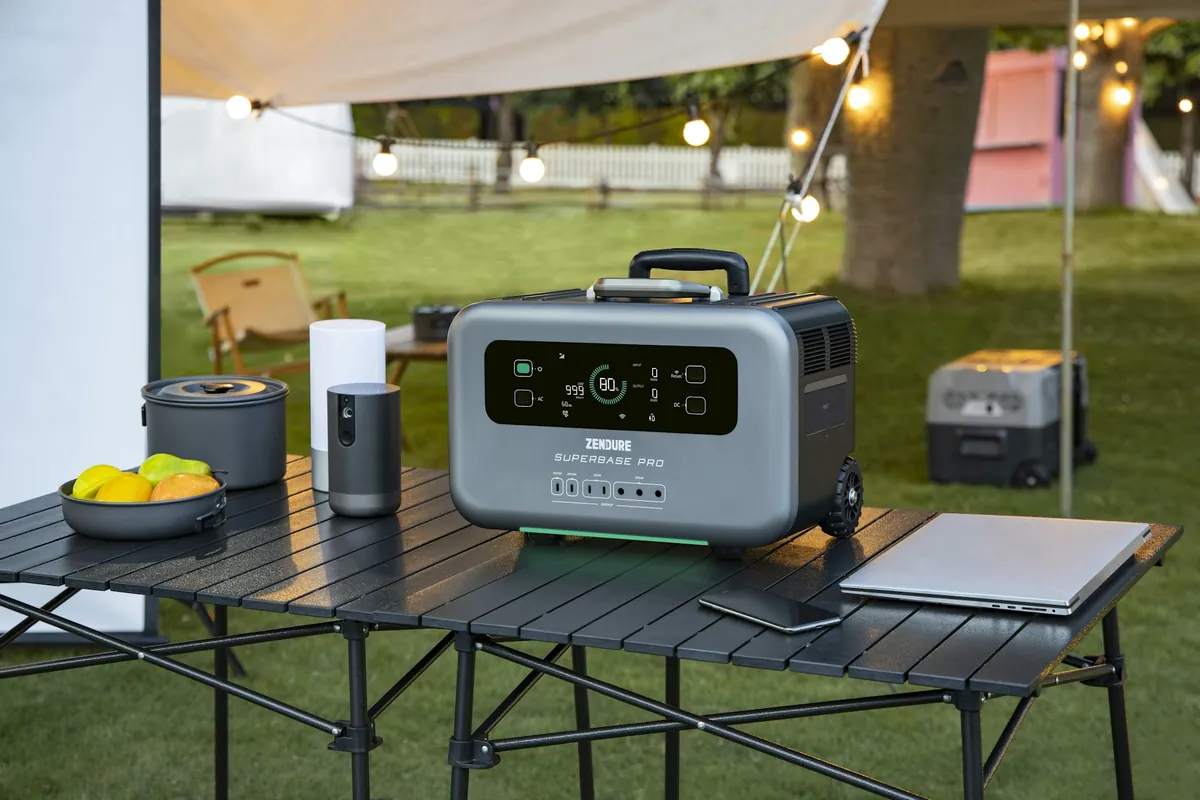
- Off-grid, bring your own power. Rental campervans do not give you access to the house battery to run a CPAP, so take a portable power station or a CPAP battery. Running the CPAP from the power station's 12V outlet with your machine's own DC converter or DC cord makes the charge last longer.
- The humidifier is the big power user. ResMed measured an AirSense 10 at about 7 W on its own, 22 W with the humidifier and 34 W with a heated tube. That is roughly 90Wh over an 8-hour night without the humidifier and up to about 470Wh with everything turned up.
- Never run your CPAP from the cab's 12V socket. It runs from the engine (starter) battery, which can go flat overnight and leave you unable to start the van.
- Most rental vans only have 240V power when plugged in at a powered site. Without one, your CPAP needs its own power source.
- Use distilled water in the humidifier (unless your tub is rated for drinking water), empty the tub every morning and never drive with water in it.

Can you use a CPAP machine in a campervan or motorhome?
Absolutely. Thousands of people with sleep apnoea (sleep apnea in the US) travel by campervan and motorhome every year, and modern CPAP and APAP machines are small, quiet and built to travel. The only real question is power: where it comes from on each night of your trip, and how long it will last.
Do not be tempted to leave the machine at home. The Sleep Health Foundation notes that skipping a night of CPAP may be OK but can bring your symptoms back, and that fatigue impairs judgement and reflexes, especially when driving. On a road trip you might be behind the wheel for hours every day, so good sleep matters more than usual.
How much power does a CPAP machine use?
Less than most people think, until you turn on the humidifier. ResMed's own measurements for an AirSense 10 AutoSet (pressure 8 to 15 cmH2O) show the heated humidifier and heated tube use far more power than the blower itself.
| Setup | Average power | Current at 12V (10 cmH2O) | Per 8-hour night at 12V |
|---|---|---|---|
| Machine only, no humidifier | 7 W | 0.93 A | About 7.5Ah |
| With humidifier (setting 4) | 22 W | 2.30 A | About 18Ah |
| With humidifier (setting 8) | - | 3.66 A | About 29Ah |
| Humidifier plus ClimateLineAir heated tube (Auto) | 34 W | 3.77 A | About 30Ah |
| Heated tube at 30°C plus humidifier at 8 | - | 4.92 A | About 39Ah |
| ResMed AirMini travel CPAP (waterless humidification) | 6.3 W typical | 0.45 A | About 3.6Ah |
Current figures are from ResMed's Battery Guide, measured through the ResMed DC converter at 12V. The nightly totals are our maths (amps x 8 hours) and do not include ResMed's 50% safety margin. Higher pressures use more power, so check the figures for your own settings.
Two things to note about newer machines. The AirSense 11 power supply is rated at 56.1 W typical and 73.2 W peak, but that is a rating for the power supply, not a measured overnight average, and ResMed has not published an AirSense 11 table like the one above. Philips does not publish a wattage figure for the DreamStation 2 at all. If you have one of these machines, plan on the AirSense 10 humidifier figures as a starting point and add a buffer.
The most reliable option: plug in at a powered site
A powered site at a holiday park, caravan park or RV park is the simplest way to run a CPAP. You plug the van into the site's power pillar with the lead supplied by the rental company, and the 240V sockets inside the van come to life. Your CPAP plugs in exactly as it does at home, humidifier and all.
In most rental campervans and motorhomes, the 240V sockets only work when the van is plugged in. That is why rental companies generally recommend staying at a powered site every night you use a CPAP. If you do plan nights off-grid, bring a portable power station or CPAP battery (see below) and test your setup on the first night. Some 4WD campers are 12V only and cannot be plugged in to mains power at all, so check before you book a 4WD campervan.
Visiting from overseas? Campervans in Australia and New Zealand use Type I power sockets (two angled flat pins plus an earth pin), so pack a plug adapter for your CPAP. Check the label on your CPAP power supply: if it says 100-240V, a plug adapter is all you need, not a voltage converter.
A few safety basics at the power pillar, from Consumer Affairs Tasmania's guidance for caravans:
- Use one continuous extension lead rated at 15 amps, fully uncoiled.
- One lead per pillar outlet. Never use double adaptors or power boards at the pillar.
- The site outlet should be protected by an RCD (safety switch). If it is not, use a portable safety switch.
Off-grid: bring your own power source
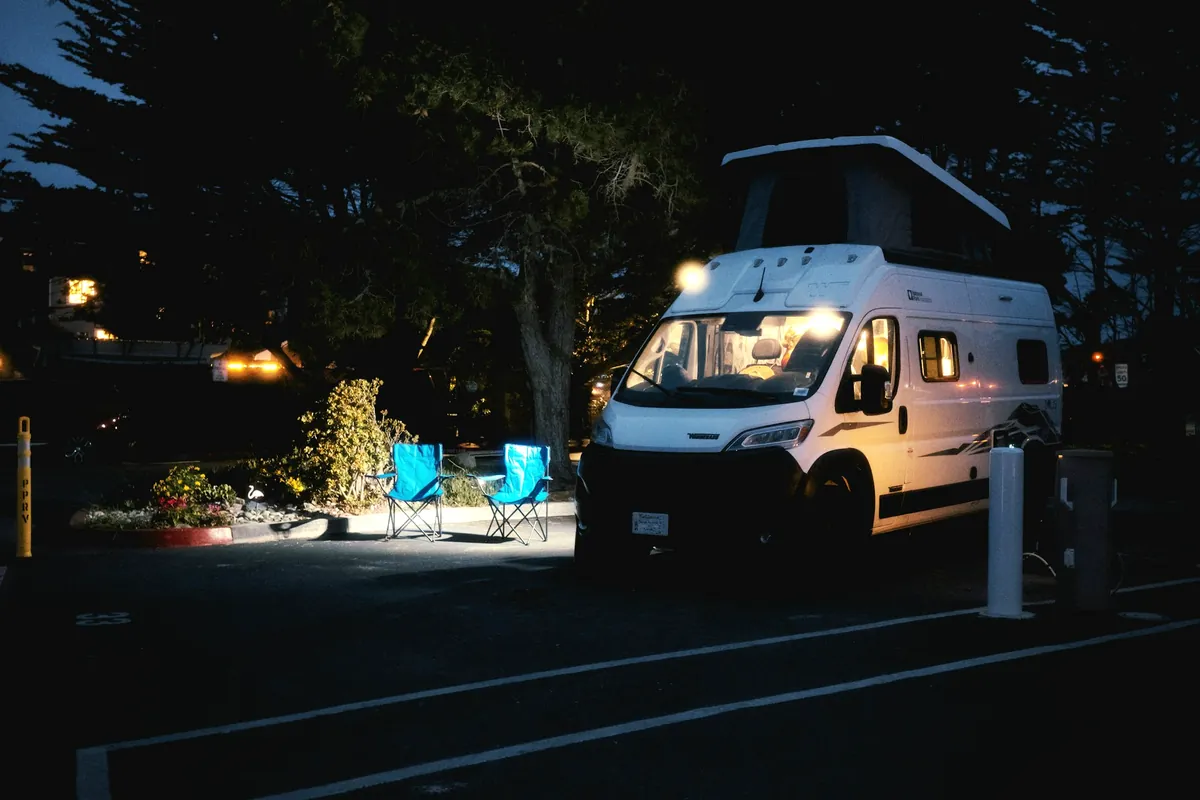
Free camps, national park campgrounds and unpowered sites have no mains power, and rental campervans do not give you access to the house battery to run a CPAP. That battery is there for the fridge, lights and water pump. For nights away from a powered site, plan to bring your own portable power station or CPAP battery.
Never use the cab's 12V socket
The 12V socket in the cab runs from the engine's starter battery. ResMed warns that running a CPAP from a vehicle that is not running may leave you unable to start the engine, and both ResMed and Philips say not to start or run the engine while the CPAP is powered from the vehicle battery, because voltage spikes can damage the machine.
Use a DC converter with your power station
Most CPAPs run on low-voltage DC inside, so plugging into a power station's 240V (AC) socket wastes power converting it up and back down again. ResMed recommends its own DC-to-DC converters over inverters because they are more efficient, regulate the voltage and protect against reverse polarity. Plug the converter into the power station's 12V outlet.
- ResMed AirSense 11 and AirCurve 11: the Air11 DC/DC Converter takes 12V or 24V input and plugs into a 12V accessory-style socket, like the one on most power stations. Its light turns amber when the battery is low, and it turns off if the battery gets too low.
- Older ResMed machines: there are matching converters for the AirSense 10, AirMini and S9 series.
- Philips DreamStation 2: Philips says to use only a Philips Respironics DC power cord and battery adapter cable. Other systems may damage the machine.
If you use the power station's AC socket instead, check that it has a pure sine wave output. ResMed's Battery Guide recommends a pure sine wave inverter rated at least 300 W continuous and 500 W peak, and warns that modified sine wave inverters can damage sensitive electronics.
How many nights will a power station run a CPAP?
It depends on the power station's size, your settings and which outlet you use. Here is a rough guide for a CPAP on its own, using ResMed's AirSense 10 figures above through a DC converter on the power station's 12V outlet.
| CPAP setup | Per 8-hour night | 300Wh station | 500Wh station | 1,000Wh station |
|---|---|---|---|---|
| No humidifier | About 90Wh | About 3 nights | About 5 nights | About 9 nights |
| Humidifier on medium | About 220Wh | About 1 night | About 2 nights | About 4 nights |
| Humidifier plus heated tube | About 360Wh | Less than 1 night | About 1 night | About 2 nights |
| Everything turned up | About 470Wh | About half a night | Just under 1 night | Almost 2 nights |
The nightly figures are ResMed's measured current at 12V multiplied by 8 hours, and the nights assume about 85% of the power station's rated capacity is usable. Using the AC socket instead adds roughly 15% for conversion losses, and ResMed advises adding a 50% safety margin on top. As a rule of thumb: without the humidifier, a mid-size power station covers several nights; with full heated humidification, plan a powered site every night or two.
Ways to stretch your charge
- Turn the humidifier down or off on warm, humid nights. It is the single biggest saving.
- Use a standard tube instead of a heated tube when it is not cold.
- Use the DC converter on the 12V outlet rather than the AC socket.
- Recharge at every powered site so you start each off-grid night full.

Can solar help?
A portable solar panel can top up a power station during the day. In sunny weather it can cover a CPAP without the humidifier, but heated humidification uses more than most small panels can put back, especially in winter, on cloudy days or when you park in the shade. Treat solar as a bonus, not a replacement for powered sites.
Choosing a CPAP battery or power station
- CPAP-specific batteries are made for travel machines. The Philips DreamStation Go overnight battery is rated at more than 8 hours but cannot run the heated humidifier, and Transcend says its P8 battery lasts up to two nights at 14 cmH2O. The ResMed AirMini has no built-in battery, so it needs an external power source.
- Portable power stations (the lithium boxes sold for camping) can run a full-size CPAP, humidifier and all. Going by the table above, a 500Wh to 1,000Wh station covers most CPAP users for a night or two off-grid, and most recharge from a normal power point at your next powered site.
Humidifier water and cleaning on the road
- Use distilled water. Philips says room-temperature distilled water only. ResMed's AirSense 11 standard tub also needs distilled water, while its cleanable tub can use drinking-quality water. Supermarkets and pharmacies sell distilled or demineralised water, so stock up in towns before heading somewhere remote.
- Empty the tub every morning and let it air dry out of direct sunlight.
- Never travel with water in the tub. ResMed says not to use the device with water in the tub while in transit, including in a vehicle. Bumpy roads can slosh water into the machine.
- Wash the mask, tube and tub weekly in warm, soapy water (not hot) and dry them in the shade. The Sleep Health Foundation and ResMed both give the same basic routine.
- Pack spares: a spare mask cushion, filters and a tube are light and could save your trip if something cracks.
Cold nights, hot days and altitude
Campervans get cold overnight in places like Tasmania, the Victorian High Country and the South Island of New Zealand, and hot by day in the outback.
- Operating temperature: both the AirSense 11 and DreamStation 2 are rated for 5°C to 35°C. On frosty nights, run the van heater or keep the machine off the cold floor.
- Rainout: water droplets in the tube and mask happen when warm, humid air cools in a cold van. Turn the tube temperature up or the humidity down, or use a heated tube. On the AirSense 11, Climate Control Auto is designed to prevent it.
- Heat: do not leave the machine in a closed van in full sun all day. Philips advises letting a device that has been very hot or very cold return to room temperature before using it.
- Altitude: most modern machines compensate automatically. The AirSense 11 is rated up to 3,010 m, the AirMini to 2,591 m and the DreamStation 2 to 2,286 m, which covers most mountain passes in Australia, New Zealand and the Rockies.
Flying in to pick up your campervan with a CPAP
Plenty of trips start with a flight to the depot. The good news:
- Your CPAP does not count as carry-on baggage on flights to, from and within the US, under US Department of Transportation rules, and ResMed says medical devices do not count toward your carry-on limit. Most airlines elsewhere treat it the same way, but check with yours.
- Take it in the cabin. TSA allows CPAPs in carry-on and checked bags, and officers may ask you to take it out of the case for screening.
- Empty the humidifier tub before you fly.
- Lithium batteries: under FAA and CASA rules, spare lithium batteries must go in carry-on. Batteries up to 100Wh are fine, between 100Wh and 160Wh need airline approval, and anything bigger is not allowed in passenger baggage. That rules out most portable power stations, so plan to buy or hire one at your destination.
- Carry a doctor's letter. The Sleep Health Foundation says it can be helpful when travelling.
CPAP, driving and your licence
In Australia, the Austroads Assessing Fitness to Drive standards say people with established sleep apnoea syndrome may hold a conditional licence if they comply with treatment and respond well to it. Transport Victoria notes that untreated sleep apnoea brings between two and seven times the risk of a road crash, and that not notifying the licensing authority may affect your insurance. In the UK, the NHS says you may need to tell the DVLA. Using your CPAP every night of your trip is part of driving safely, so build your itinerary around it.
Choosing a rental campervan or motorhome as a CPAP user
Ask the rental company these questions before you book:
- Can it plug in to 240V at powered sites, and is the lead included?
- Where is the nearest power outlet to the bed? CPAP tubes are usually about 1.8 to 2 m long.
- Is there a safe, flat spot beside the bed for your CPAP and a power station?
- Do they offer a power station as an extra? If not, plan to buy or hire one at your destination.
Bigger motorhomes usually have more space beside the bed for your CPAP and a power station, which makes CPAP life easier. Compact campervans work well too if you plan for powered sites or bring a power station. Browse our campervan company guides to compare what each brand offers, and read our first-timer's campervan hire tips if this is your first trip.
CPAP campervan packing checklist
- CPAP machine, mask, tube and power supply
- DC converter or DC cord for your exact model, to run from a power station's 12V outlet
- Distilled water (or a plan to buy it along the way)
- Spare mask cushion, filters and tube
- Mask wipes and a small bottle of mild detergent
- Portable power station or CPAP battery for nights off-grid
- Doctor's letter and your supplier's contact details
- A list of powered sites along your route, booked ahead in school holidays
Planning where to go? See our guide to summer vs winter campervan travel in Australia, or compare vans in Australia, New Zealand, the USA and Canada. Freedom camping in New Zealand? Check the NZ freedom camping rules first, as you will be relying on your own power.
Sources
Figures were checked against manufacturer and official sources on 27 October 2026. Always follow the user guide for your own machine.
- Battery Guide: using stand-alone, deep-cycle batteries (ResMed)
- Power consumption of Air10 devices (ResMed)
- AirSense 11 user guide (ResMed)
- Air11 DC/DC Converter user guide (ResMed)
- DreamStation 2 user manual (Philips Respironics)
- Travelling with CPAP and Caring for your CPAP equipment (Sleep Health Foundation)
- Assessing Fitness to Drive: sleep disorders (Austroads)
- Using electricity safely in caravans and tents (Consumer Affairs Tasmania)
- Lithium batteries (FAA PackSafe)
- Lithium batteries 100Wh to 160Wh (CASA)
- Nebulizers, CPAPs, BiPAPs and APAPs (TSA)